double side 3d letters sign side view drawing

Case of a court card, postmarked 1899, showing Robert Burns and his cottage and monument in Ayr
A postcard or postal service carte du jour is a slice of thick paper or thin cardboard, typically rectangular, intended for writing and mailing without an envelope. Non-rectangular shapes may too be used simply are rare. There are novelty exceptions, such as wooden postcards, copper postcards sold in the Copper Country of the U.S. state of Michigan, and coconut "postcards" from tropical islands[ clarification needed ].
In some places, one can send a postcard for a lower fee than a letter of the alphabet. Postage stamp collectors distinguish between postcards (which require a postage stamp) and postal cards (which take the postage pre-printed on them). While a postcard is usually printed and sold by a private visitor, individual or organization, a postal card is issued by the relevant postal dominance (often with pre-printed postage).[1]
Production of postcards blossomed in the late 19th and early 20th centuries.[ii] As an easy and quick way for individuals to communicate, they became extremely popular.[2] The study and collecting of postcards is termed deltiology (from Greek deltion , minor writing tablet, and English -logy, the report of).[ane]
Historical overview [edit]
1840 to 1864 [edit]

Cards with messages accept been sporadically created and posted by individuals since the beginning of postal services. The earliest known picture postcard was a hand-painted design on card created by the writer Theodore Hook. Hook posted the card, which bears a penny blackness stamp, to himself in 1840 from Fulham (office of London).[3] [4] He probably did so as a practical joke on the postal service, since the image is a caricature of workers in the post office.[4] [5] In 2002 the postcard sold for a tape £31,750.[4]
In the United States, the custom of sending through the mail, at letter rate, a picture or blank card stock that held a message, began with a bill of fare postmarked in December 1848 containing printed advertising.[6] The get-go commercially produced carte was created in 1861 past John P. Charlton of Philadelphia, who patented a private postal card, and sold the rights to Hymen Lipman, whose postcards, consummate with a decorated border, were marketed as "Lipman's Postal Menu".[one] [two] These cards had no images. While the United States government allowed privately printed cards equally early on as Feb 1861, they saw little use until 1870, when experiments were done on their commercial viability.[7] [ii]
Offset postals and private postcards (ca. 1865 to 1880) [edit]

"Feldpost-Correspondenzkarte" (lit. field postal service correspondence card) used during the Franco-Prussian War of 1870.
A Prussian postal official, Heinrich von Stephan, outset proposed an "open post-sheet" made of stiff paper in 1865.[seven] [1] [eight] He proposed that one side would be reserved for a recipient address, and the other for a brief message.[eight] His proposal was denied on grounds of being besides radical and officials did non believe anyone would willingly give up their privacy.[8] In October 1869, the post role of Austro-hungarian empire accepted a similar proposal, also without images, and 3 meg cards were mailed within the get-go 3 months.[ane] [8] With the outbreak of the Franco-Prussian War in July 1870, the authorities of the North German Confederation decided to take the advice of Austrian Emanuel Herrmann and issued postals for soldiers to inexpensively send home from the field.[seven] [1]
The period from 1870 to 1874 saw a great number of countries brainstorm the issuance of postals. In 1870, the North German Confederation was joined past Baden, Bavaria, Corking Britain, Grand duchy of luxembourg and Switzerland.[seven] [9] The year 1871 saw Belgium, Canada, Kingdom of denmark, Finland, the netherlands, Kingdom of norway, and Sweden introduce their own postals.[seven] [nine] People's democratic republic of algeria, Republic of chile, French republic and Russia did and then in 1872, and were followed by France, Japan, Romania, Serbia, Spain and the The states between 1873 and 1874.[9] [vii] Many of these postals included modest images on the same side every bit the postage.[7] Postcards began to exist sent internationally later the first Congress of the General Postal Wedlock, which met in Bern, Switzerland in October 1874.[nine] [10] The Treaty of Bern was ratified in the United States in 1875.[10]

The claimed get-go printed movie postcard.
The outset known printed picture postcard, with an paradigm on one side, was created in French republic in 1870 at Camp Conlie by Léon Besnardeau (1829–1914). Conlie was a grooming camp for soldiers in the Franco-Prussian War. The cards had a lithographed design printed on them containing emblematic images of piles of armaments on either side of a scroll topped past the arms of the Duchy of Brittany and the inscription "War of 1870. Military camp Conlie. Gift of the National Defence. Ground forces of Brittany" (in French).[11] While these are certainly the first known picture postcards, at that place was no space for stamps and no show that they were always posted without envelopes.[12]
In Germany, the bookdealer August Schwartz from Oldenburg is regarded as the inventor of the illustrated postcard. On July sixteen, 1870, he mailed a post correspondence card with an image of a man with a cannon, signaling the looming Franco-Prussian war.[13] [xiv]
In the post-obit year the first known moving picture postcard in which the image functioned as a gift was sent from Vienna.[15] The first advertising carte du jour appeared in 1872 in Great United kingdom and the first High german carte du jour appeared in 1874. Private advertising cards started appearing in the United States around 1873, and qualified for a special postage rate of ane cent.[7] Private cards inspired Lipman's card were also produced meantime with the U.S. government postal in 1873.[7] [one] The backs of these private cards contained the words "Correspondence Bill of fare", "Mail Card" or "Souvenir Card" and required two-cent postage if they were written upon.[7] [two]
Golden age of postcards (ca. 1890 to 1915) [edit]
Cards showing images increased in number during the 1880s. Images of the newly congenital Eiffel Belfry in 1889 and 1890 gave impetus to the postcard, leading to the and so-called "aureate historic period" of the picture postcard.[7] This golden age began slightly earlier in Europe than the United States, likely due to a depression in the 1890s.[7] Nonetheless, the Chicago World's Fair in 1893 excited many attendees with its line of "Official Souvenir" postals, which popularized the idea of flick postcards.[1] [sixteen] The stage was now prepare for individual postcard industry to boom, which it did once the United States government inverse the postage charge per unit for private cards from two cents to one in May 1898.[1] [sixteen]
Spanning from approximately 1905 to 1915 in the United States, the gold historic period of postcards stemmed from a combination of social, economic, and governmental factors.[i] [xvi] Need for postcards increased, government restrictions on product loosened, and technological advances (in photography, printing, and mass production) made the boom possible.[1] In addition, the expansion of Rural Gratis Delivery allowed mail to be delivered to more American households than ever before.[1] Billions of postcards were mailed during the golden age, including nigh a billion per year in United states of america from 1905 to 1915, and 7 billion worldwide in 1905.[17] [xviii] Many postcards from this era were in fact never posted but directly caused by collectors themselves.[19]

Austrian postcard from 1901.
Despite years of incredible success, economical and regime forces would ultimately spell the finish of the gilt age. The peak came quondam between 1907 and 1910 for the United States.[1] [2] In 1909, American publishers successfully lobbied to place tariffs on loftier quality High german imports with the Payne-Aldrich Tariff Act.[1] The effects of tariffs really started to make a large impact, and escalating hostilities in Europe made it difficult to import cards and ink into the United States.[1] The fad may have also simply run its natural course.[1] The war disrupted production efforts in Europe, although postcard production did non entirely stop.[20] Cards were still useful for propaganda, and for boosting troop morale.[17] [20] [21]
Post-World War I (1918 to nowadays) [edit]

Postcard depicting Dalhousie Street, Amherstburg, Ontario in [ca. 1920] from the Alvin D. McCurdy fonds held at the Archives of Ontario.
After the war, the production of postcards continued, albeit in different styles than before. Need for postcards decreased, particularly every bit telephone usage grew.[1] There was however a need for postcards, which would be dubbed the "poor man'south telephone".[22] Equally tastes inverse, publishers began focusing on scenic views, humor, and fashion.[20] "White border" cards, which existed prior to the war, were produced in greater numbers from roughly 1915 to 1930 in the Usa.[1] [2] They required less ink and had lower production standards than fine German cards.[20] These were afterward replaced by "linen" postcards in the 1930s and 1940s, which used a printing procedure popularized past Curt Teich.[1] [ii] Finally, the modern era of Photochrom (often shortened just to "chrome") postcards began in 1939, and gained momentum around 1950.[2] These sleeky, colorful postcards are what we most commonly encounter today.[2] Postcard sales dropped to effectually 25% of 1990s levels,[23] with the growing popularity of social media around 2007, resulting in closure of long-established printers such as J Salmon Ltd in 2017.[24]
Land specifics [edit]
India [edit]
In July 1879, the Post Office of India introduced a quarter anna postcard that could be posted from one place to another inside British India. This was the cheapest form of mail provided to the Indian people to date and proved a huge success. The institution of a large postal system spanning Bharat resulted in unprecedented postal access: a message on a postcard could be sent from one part of the country to another part (often to a physical address without a nearby mail service office) without additional postage affixed. This was followed in Apr 1880 by postcards meant specifically for government use and by reply postcards in 1890.[25] : 423–424 The postcard facility continues to this date in independent India.
Japan [edit]
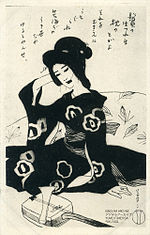
Official postcards were introduced in Dec 1873, shortly after stamps were introduced to Japan.[26] [27] Render postcards were introduced in 1885, sealed postcards in 1900, and individual postcards were allowed from 1900.[26]
In Japan, official postcards have one side dedicated exclusively to the address, and the other side for the content, though commemorative pic postcards and individual moving-picture show postcards too be. In Nippon today, two particular idiosyncratic postcard customs exist: New year'due south Day postcards ( 年賀状 , nengajō ) and render postcard s ( 往復はがき , ōfuku-hagaki ). New Year's Twenty-four hour period postcards serve every bit greeting cards, similar to Western Christmas cards, while return postcards office similarly to a self-addressed stamped envelope, allowing i to receive a respond without burdening the addressee with stamp fees. Return postcards consist of a single double-size canvass, and cost double the price of a usual postcard – ane addresses and writes one half as a usual postcard, writes i's ain address on the return menu, leaving the other side blank for the respond, then folds and sends. Return postcards are near frequently encountered by non-Japanese in the context of making reservations at certain locations that only accept reservations by render postcard, notably at Saihō-ji (moss temple). For overseas purposes, an international respond coupon is used instead.
Russia [edit]
In the State Standard of the Russia "GOST 51507-99. Postal cards. Technical requirements. Methods of Control" (2000)[28] gives the following definition:
Post Card is a standard rectangular form of a paper for public postings. According to the same state standards, cards are classified according to the type and kind.
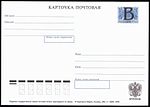
Standard stamped postcard Russian federation
Depending on whether or not the paradigm on the card printing postage stamp postage cards are divided into ii types:
- marked;
- unmarked.
Depending on whether or not the card illustrations, cards are divided into 2 types:
- illustrated;
- unproblematic, that is non-illustrated.
Cards, depending on the location of illustrations divided into:
- Vector carte at the location on the front end side;
- on the reverse side.
Depending on the walking area cards subdivided into:
- cards for shipment within the Russian Federation (internal postal service);
- cards for shipment outside of the Russian Federation (international postage).
United kingdom of great britain and northern ireland [edit]
History [edit]
In Britain, postcards without images were issued past the Post Office in 1870, and were printed with a postage as part of the design, which was included in the cost of purchase. These cards came in ii sizes. The larger size was plant to exist slightly too large for ease of treatment, and was soon withdrawn in favour of cards 13mm ( ane⁄ii inch) shorter.[29] 75 million of these cards were sent within Britain during 1870.[8]
In 1973 the British Postal service Office introduced a new type of carte, PHQ Cards, pop with collectors, especially when they have the appropriate stamp affixed and a commencement mean solar day of issue postmark obtained.
Seaside postcards [edit]
In 1894, British publishers were given permission by the Royal Mail to manufacture and distribute picture postcards, which could be sent through the post. It was originally thought[ by whom? ] that the offset UK postcards were produced by printing firm Stewarts of Edinburgh only later research, published in Picture Postcard Monthly in 1991, has shown that the outset UK pic menu was published past ETW Dennis of Scarborough.[30] Two postmarked examples of the September 1894 ETW Dennis card have survived just no cards of Stewarts dated 1894 have been found.[31] Early postcards were pictures of landmarks, scenic views, photographs or drawings of celebrities and and then on. With steam locomotives providing fast and affordable travel, the seaside became a popular tourist destination, and generated its own gift-manufacture.

In the early on 1930s, cartoon-style saucy postcards became widespread, and at the peak of their popularity the sale of saucy postcards reached a massive 16 million a year. They were ofttimes earthy in nature, making apply of innuendo and double entendres, and traditionally featured stereotypical characters such every bit vicars, large ladies, and put-upon husbands, in the same vein as the Bear On films.
In the early 1950s, the newly elected Conservative regime were concerned at the apparent deterioration of morals in the U.k. and decided on a crackdown on these postcards. The primary target of their campaign was the postcard creative person Donald McGill. In the more liberal 1960s, the saucy postcard was revived and later came to exist considered, by some, every bit an fine art form.[32]
Original postcards are now highly sought after, and rare examples tin control high prices at auction. The best-known saucy seaside postcards were produced by the publishing company Bamforths of Holmfirth, West Yorkshire.
Despite the decline in popularity of postcards that are overtly "saucy", postcards continue to exist a significant economic and cultural aspect of British seaside tourism. Sold by newsagents and street vendors, as well every bit by specialist souvenir shops, modern seaside postcards frequently feature multiple depictions of the resort in unusually favourable conditions conditions. John Hinde used saturated colour and meticulously planned his photographs, which fabricated his postcards of the subsequently twentieth century become collected and admired as kitsch. Such cards are also respected every bit important documents of social history, and have been influential on the work of Martin Parr.
United States [edit]
Postcard eras [edit]

A 1908 postcard of a postcard mill in Chicago, which claims to be 'The largest building in America devoted exclusively to the manufacture of Mail service Cards'
At that place are several common motifs present in American postcard design, most shaped by production practices and laws in place at the fourth dimension of product. These have been identified by deltiologists and grouped together into what are commonly referred to every bit eras or periods which describe a postcard's style or method of production. While features of these eras, such every bit a divided dorsum, are present in other countries as well, the dates of production may differ. For example, "divided back" postcards were introduced to Great U.k. in 1902, 5 years before the United States.[33] The gold historic period of postcards is commonly defined in the United States as starting around 1905, peaking betwixt 1907 and 1910, and ending past World War I.[19] [i] [34] Listed here are eras of production for specific types of postcards, every bit typically defined by deltiologists. Almost of the dates are not stock-still dates, only approximate points in time as in that location was a lot of overlap in production.[ii] These volition be further elaborated upon in the following sections.
- Pioneer, 1870-1898[2]
- Alternate start dates include 1873 (get-go government postal issued)[35] and 1893 (Globe's Columbian Exposition)[36] [37]
- Private Mailing Card‚ 1898-1901[2] [36]
- Undivided Back‚ 1901-1907[2] [35]
- Occasionally called the "Post Card" era[2] [36]
- Divided Back‚ 1907-1915[2] [36] [35]
- White Border‚ 1915-1930[ii] [36] [35]
- Linen‚ 1930-1945[two] [36] [35]
- Photochrom(e)‚ 1939–present[2] [36] [35]
Others styles of postcards have fairly established dates of production equally well. These are not typically referred to as eras, as they were never the predominate type at whatsoever given time.
- Existent Photo‚ 1903–present[36] [35]
- Began with the introduction of a Kodak camera in 1903[1] [ii]
- Leather‚ 1900-1909[38] [39] [xl] [41]
- References to "leather postals" and "leather post cards" began to announced in newspapers across the U.s.a. in belatedly 1904 and were in popular use by Valentine'south Day of 1905.[42] [43] [44] [45] [46] [47] [48] [49]
History [edit]
Pioneer era [edit]
Nether an act passed by the U.Due south. Congress on February 27, 1861, privately printed cards (which weighed i ounce or less) were allowed to be sent equally mail.[ii] John P. Charlton copyrighted the beginning postcard in America that same yr.[2] The rights to this card were later sold to Hymen L. Lipman, who began reissuing the cards under his proper name in 1870.[ii] The U.Southward. Postmaster General John Creswell recommended to the U.Southward. Congress i-cent postal cards in November 1870.[one] Legislation was passed on June viii, 1872, which allowed the government to produce postal cards.[2]
By police, only government-issued postcards were immune to say "Postal Card".[two] Privately printed postcards were still immune but they were more than expensive to postal service (two-cent postage versus one-cent for government cards).[2] Backs of these individual cards typically contained the words "Correspondence Card", "Mail Carte" or "Souvenir Card".[seven] [2] The Morgan Envelope Factory of Springfield, Massachusetts claims to have produced the first American postcard in 1873.[50] [51]
Political hold-ups including concerns by future President James Garfield (the Representative), delayed issuance of the official government postal.[1] Finally, it was issued in May 1873, and first went on sale in Springfield, Massachusetts on May 12 of that year.[1] [2] Co-ordinate to The New York Times, postal clerks in the city sold 200,000 cards within 2.v hours on May fourteen.[1] Nationwide, 31 1000000 postal cards were sold past the end of June 1873, and more than 64 million by the end of September.[1] The numbers but continued to grow through 1910.[1]
World's fairs [edit]
In that location were many world'south fairs and expositions held beyond the United States in the belatedly 19th and early 20th centuries. The outset to be depicted in an early ad postcard was the Interstate Industrial Exposition that took place in Chicago in 1873.[52] As that exposition carte was not intended to be a gift, the first postcard to be printed explicitly every bit a gift in the United States was created for the 1893 Globe'due south Columbian Exposition, also in Chicago.[52] [sixteen] [9] In that location were 120 different images of the exposition printed on government postals past private distributors.[7] Among the nigh popular, was Charles West. Goldsmith's ready of 10 postcard designs (in full colour) showing the exposition buildings.[vii] [53] Governmental postal cards, and private souvenir cards featuring buildings and exposition grounds remained pop staples of future expositions.[ane] [16]
Ane big botch occurred at the 1895 Cotton fiber States and International Exposition in Atlanta.[one] All of the postcards there were printed on patently card stock, so most people assumed they were government-issued postals requiring one cent for postage instead of two.[i] The incident made the headlines.[1]
Golden age of postcards [edit]


The U.S. Congress passed an act on May 19, 1898 which immune private printers and publishers to officially produce postcards, and for them to be posted at the same rate every bit authorities-produced postals (ane-cent, previously two).[2] [54] Until this fourth dimension, privately printed cards bore the terms "Correspondence Card", "Mail service Card" or "Souvenir Card".[seven] [2] The act at present required private cards to state "Private Mailing Carte du jour, Authorized past Act of Congress of May 19, 1898".[two] Hence, deltiologists have referred to this as the "Private Mailing Menu Act".
This prohibition on verbiage was rescinded on December 24, 1901, past the Postmaster-General, who issued Mail Office Order No. 1447.[2] It allowed private postcards to use the term "Post Card" on their backs.[ii] The club also shortened the requirement and allowed private publishers to omit the citation to the 1898 human activity.[2] Nonetheless, correspondents could only write on the front end of the postcard, the back was reserved for the recipient's address.[2] This has become known every bit the "undivided back" era of postcards.[2]
The Universal Postal Congress decreed that government-issued postcards in the United States could contain messages on the address side start March one, 1907.[2] In line with these changes, the United States Congress passed an human activity on March 1, 1907, which extended this to privately produced cards.[2] [52] These laws were further tweaked by orders of the U.S. Postmaster-General that aforementioned year.[2] This ushered in the "divided back" era of postcards, which lasted until World War I.[ii] On these cards the back is divided into two sections: the left section is used for the message and the right for the address.[2]

1905 postcard with 'undivided dorsum'

Postcard with 1908 cancellation
Thus began the "golden historic period" of American postcards, which roughly spanned from 1905 to the First Earth War.[one] Others define the "Golden Age" as aligning more closely with the "divided back" era.[two] Regardless, it peaked betwixt 1907 and 1910, and started to pass up with the introduction of tariffs on German-printed postcards in 1909.[55] [1] [two] [sixteen] The postcard craze between 1907 and 1910 was especially popular amongst rural and modest-town women in Northern U.South. states.[34] Many social, economic, and governmental factors combined to create the postcard boom.[1] Need for postcards increased, government restrictions on production loosened, and technological advances (in photography, printing, and mass production) fabricated it possible.[1] [16] In add-on, the expansion of Rural Complimentary Commitment allowed mail to be delivered to more American households than ever before.[1] Other factors included shifts in creative taste among the public, and the development of a auction and distribution network of jobbers and importers—connecting Main Street America with German printers.[16] Billions of postcards were posted during the golden historic period, with nearly 700 million postcards mailed during the year ending June 30, 1908 alone.[xvi]

American 'divided back' postcard, 1916
The decline began with the Payne-Aldrich Tariff Human activity of 1909, which was more often than not lobbied for by American publishers who did not wish to compete with German publishers.[16] [1] By some estimates, the new tariffs on postcards were an increase of 300 percent.[56] Many distributors imported large quantities of German-produced cards before the tariffs took effect, causing a overabundance in the market.[55] [16] German publishers began moving product to the United States shortly after the Payne-Aldrich Tariff Act to keep selling to the American market place.[57] Ultimately, the tariffs contributed to the finish of the "golden historic period" as publishing quality decreased (American technology lagged behind German language), and equally public interest in collecting waned.[16] [2] The National Postcard Association was formed to gainsay unfair practices, depression prices, and an excessive amount of unsalable postcards.[sixteen] Effects of the tariffs were reinforced past the British naval occludent of German merchant ships at the outbreak of World War I in 1914.[20] Postcard manufacturers called off their annual conventions that twelvemonth, and many shifted to greeting card production.[xvi] The war cut off the importation of fine German-produced cards likewise as dyes used for ink—which were largely produced by the High german Empire.[20] [58] Production of some postcards would keep during the state of war, to support propaganda efforts and troop morale.[xx]
Mail service-World War I [edit]
In response to the war-time shortages of ink, and the restrictions placed on importation, American publishers began producing larger quantities of postcards which featured a white border on the edges.[20] Although these were seen occasionally prior to the war, this design change allowed publishers to salvage ink and lowered the precision threshold for cutting the cards.[xx] The "white border" era would last from about 1913 to 1930.[xx] During this period, public tastes had changed and publishers began focusing more on scenic views, humor, style, and surrealism.[20]
Mid-century "linen" postcards were produced in peachy quantity from 1930 to 1945, although they connected to exist produced more than than a decade afterward the introduction of Photochrom cards.[2] Despite the name, "linen" postcards were non produced on a linen material, but used newer printing processes that used an cheap menu stock with a loftier rag content, and were so finished with a pattern which resembled linen.[2] The face of the cards is distinguished by a textured cloth appearance which makes them easily recognizable. The reverse of the card is smooth, similar earlier postcards. The rag content in the bill of fare stock allowed a much more colorful and vibrant image to exist printed than the earlier "white border" style. Due to the inexpensive product and vivid realistic images they became popular.
1 of the better known "linen-era" postcard manufacturers was Brusque Teich and Company, who first produced the immensely popular "large letter linen" postcards (amongst many others). The card blueprint featured a large letter spelling of a country or place with smaller photos inside the letters. The blueprint tin still be found in many places today. Other manufacturers include Tichnor and Company, Haynes, Stanley Piltz, E.C. Kropp, and the Asheville Postcard Company. Cards printed past Curt Teich and Company typically included product numbers in the postage box, which can be used for dating.[59]

The Great White Liner "South American," Chicago, Illinois, circa 1915-1930. Curt Teich & Co. postcard 103504.
By the late 1920s new colorants had been developed that were very enticing to the press industry. Though they were best used as dyes to show off their brightness, this proved to be problematic. Where traditional pigment based inks would prevarication on a paper'due south surface, these thinner watery dyes had a tendency to be absorbed into a paper's fibers, where it lost its reward of higher color density, leaving behind a dull blurry finish. To feel the rich colors of dyes light must be able to pass through them to excite their electrons. A partial solution was to combine these dyes with petroleum distillates, leading to faster drying heatset inks. But it was Curt Teich who finally solved the problem by embossing paper with a linen texture before printing. The embossing created more surface area, which allowed the new heatset inks to dry even faster. The quicker drying fourth dimension allowed these dyes to remain on the paper'southward surface, thus retaining their superior strength, which requite Linens their telltale bright colors. In add-on to printing with the usual CYMK colors, a lighter blue was sometimes used to requite the images actress punch. Higher speed presses could as well accommodate this method, leading to its widespread use. Although first introduced in 1931, their growing popularity was interrupted by the outbreak of war. They were not to be printed in numbers again until the later 1940s, when the state of war effort ceased consuming about of the country's resources. Even though the images on linen cards were based on photographs, they contained much handwork of the artists who brought them into production. There is of form nothing new in this; what information technology notable is that they were to be the final postcards to show whatsoever touch of the human hand on them. In their last days, many were published to look more like photograph-based chrome cards that began to boss the market. Textured papers for postcards had been manufactured ever since the plow of the century. But since this procedure was not then a necessary step in aiding card product, its added cost kept the process limited to a handful of publishers. Its original use most likely came from attempts to simulate the texture of canvas, thus relating the postcard to a painted work of fine art.[60]

A tinted (black-and-white image that has had colored tint added) souvenir card. Image of the Christopher Columbus taken circa 1896
Globe War 2 to present [edit]
The concluding and current postcard era, which began nigh 1939, is the "chrome" era, a shortened version of Photochrom (without the 'e' in American English; with in British English).[2] However these types of cards did non brainstorm to dominate until well-nigh 1950 (partially due to war shortages during WWII).[two] The images on these cards are generally based on colored photographs, and are readily identified by the glossy appearance given by the paper's coating. 'These still photographs made the invisible visible, the unnoticed noticed, the circuitous simple and the simple complex. The power of the still photograph forms symbolic structures and make the epitome a reality', as Elizabeth Edwards wrote in her book: The Tourist Prototype: Myths and Myth Making in Tourism.[61]
Standards [edit]
The United States Postal Service defines a postcard as: rectangular, at least 3+ 1⁄2 inches (88.9 mm) loftier × 5 inches (127 mm) long × 0.007 inches (0.178 mm) thick and no more than 4+ one⁄4 inches (108 mm) high × half-dozen inches (152.four mm) long × 0.016 inches (0.406 mm) thick.[62] However, some postcards accept deviated from this (for instance, shaped postcards).
Controversies [edit]
Legalities and censorship [edit]
The initial appearance of moving picture postcards (and the enthusiasm with which the new medium was embraced) raised some legal problems. Picture postcards allowed and encouraged many individuals to send images across national borders, and the legal availability of a postcard image in ane country did not guarantee that the carte would be considered "proper" in the destination land, or in the intermediate countries that the card would have to pass through. Some countries might pass up to handle postcards containing sexual references (in seaside postcards) or images of full or partial nudity (for example, in images of classical bronze or paintings). For example, the United States Mail service would only allow the delivery of postcards showing a back view of naked men from U.k. if their posteriors were covered with a blackness bar.[63] Early postcards often showcased photography of nude women. Illegal to produce in the United states of america, these were commonly known every bit French postcards, due to the large number of them produced in France. Other countries objected to the inappropriate use of religious imagery. The Ottoman Empire banned the sale or importation of some materials relating to the Islamic prophet Muhammad in 1900. Affected postcards that were successfully sent through the Ottoman Empire earlier this engagement (and are postmarked accordingly) accept a high rarity value and are considered valuable by collectors.
Lynchings [edit]
In 1873, the Comstock Act was passed in the Usa, which banned the publication of "obscene matter as well as its circulation in the mails".[64] In 1908, §3893 was added to the Comstock Human action, stating that the ban included material "tending to incite arson, murder, or assassination".[64] Although this human activity did not explicitly ban lynching photographs or postcards, information technology banned the explicit racist texts and poems inscribed on sure prints. According to some, these texts were accounted "more than incriminating" and acquired their removal from the postal service instead of the photo itself because the text fabricated "besides explicit what was e'er implicit in lynchings".[64] Some towns imposed "cocky-censorship" on lynching photographs, but section 3893 was the get-go step towards a national censorship.[64] Despite the amendment, the distribution of lynching photographs and postcards continued. Though they were not sold openly, the censorship was bypassed when people sent the material in envelopes or mail wrappers.[65]
Globe War I [edit]
Censorship played an important role in the First Earth War.[66] Each country involved utilized some form of censorship. This was a way to sustain an temper of ignorance and give propaganda a risk to succeed.[66] In response to the war, the United states of america Congress passed the Espionage Human activity of 1917 and Sedition Deed of 1918. These gave broad powers to the government to censor the press through the utilise of fines, and later on any criticism of the authorities, ground forces, or sale of state of war bonds.[66] The Espionage Deed laid the groundwork for the establishment of a Central Censorship Board which oversaw censorship of communications including cable and postal service.[66]
Postal command was eventually introduced in all of the armies, to discover the disclosure of military secrets and test the morale of soldiers.[66] In Allied countries, civilians were too subjected to censorship.[66] French censorship was minor and more targeted compared to the sweeping efforts made by the British and Americans.[66] In Keen Britain, all mail was sent to censorship offices in London or Liverpool.[66] The United states of america sent postal service to several centralized mail offices as directed past the Central Censorship Lath.[66] American censors would but open mail related to Spain, Latin America or Asia—as their British allies were handling other countries.[66] In one calendar week alone, the San Antonio mail role processed more than than 75,000 messages, of which they controlled 77 percent (and held xx percent for the following week).[66]
Soldiers on the front developed strategies to circumvent censors.[67] Some would get on "home leave" and take messages with them to mail service from a remote location.[67] Those writing postcards in the field knew they were beingness censored, and deliberately held back controversial content and personal matters.[67] Those writing home had a few options including free, government-issued field postcards, cheap, pic postcards, and embroidered cards meant as keepsakes.[68] Unfortunately, censors oftentimes disapproved of picture postcards.[68] In i case, French censors reviewed 23,000 letters and destroyed only 156 (although 149 of those were illustrated postcards).[68] Censors in all warring countries too filtered out propaganda that disparaged the enemy or approved of atrocities.[66] For example, High german censors prevented postcards with hostile slogans such as "Jeder Stoß ein Franzos" ("Every hit a Frenchman") among others.[66]
Historical value [edit]
Postcards certificate the natural landscape as well as the built surroundings—buildings, gardens, parks, cemeteries, and tourist sites. They provide snapshots of societies at a fourth dimension when few newspapers carried images.[16] Postcards provided a way for the general public to keep in touch with their friends and family, and required petty writing.[sixteen] Anytime there was a major event, a postcard photographer was there to document it (including celebrations, disasters, political movements, and even wars).[16] Commemorating popular humor, amusement, manner, and many other aspects of daily life, they also shed lite on transportation, sports, work, organized religion, and advertising.[16] Cards were sent to convey news of death and birth, store purchases, and employment.[xvi]
As a primary source, postcards are incredibly important to the types of historical enquiry conducted past historians, historic preservationists, and genealogists akin. They give insight into both the physical world, and the social earth of the time. During their heyday postcards revolutionized communication, similar to social media of today.[8] For those studying communication, they highlight the adoption of media, its adaptation, and its ultimate discarding.[8] Postcards have been used to report topics as diverse equally theatre, racial attitudes, and war.[69] [xviii] [lxx]
Digital collections [edit]
Libraries, archives, and museums take extensive collections of motion-picture show postcards; many of the postcards in these collections are digitized[71] Efforts are continuously being made by professionals in these fields to digitize these materials to brand them more widely accessible to the public. For those interested, there are already several large collections viewable online. Some big digital collections of postcards include:
- OldNYC (New York Public Library)
- Digital Collections (New York Public Library)
- These collections include the Detroit Publishing Company, vacation postcards, WWI postcards, and more.
- Short Teich Postcard Archives Digital Collection (Newberry Library)
- The Pendergast Years (Kansas City Public Library)
- Northwest Historical Postcards Collection (University of Idaho)
- Kansas Urban center, Kansas Postcard Drove (Kansas City, Kansas Public Library)
- Ernest G. Best postcard collection of merchant vessels, naval vessels and sailing vessels, 1900-1940. Country Library of New South Wales, PXE 722/Items 1-4961.
Collecting [edit]
It is likely that postcard collecting first began as shortly as postcards were mailed. One could argue that actual collecting began with the acquisition of souvenir postcards from the earth's fairs, which were produced specifically with the collector (souvenir hunter) in mind.[16] Later, during the gilt historic period of postcards, collecting became a mainstream craze.[xvi] The frenzy of purchasing, mailing, and collecting postcards was often referred to every bit "postcarditis", with up to half purchased by collectors.[72] [19] Clubs such equally The Jolly Jokers, The Society for the Promulgation of Post Cards, and the Post Card Matrimony sprang upwards to facilitate postcard exchanges, each having thousands of members.[17] Postcard albums were commonly seen in Victorian parlors, and had a place of prominence in many middle and upper class households.[xvi]
Today, postcard collecting is all the same a popular and widespread hobby. The value of a postcard is mainly determined by the image illustrated on it. Other important factors for collectors can be countries, issuers, and authors. Online catalogs can exist found on collector websites and clubs.[73] These catalogs provide detailed information almost each postcard aslope their picture. In addition, these websites include drove management tools, trading platforms, and forums to help with discussions between collectors. The oldest continuously run club in the United States is the Metropolitan Postcard Order of New York Urban center, founded in 1946.[74]
Glossary of terminology [edit]
Nigh of the terms on this listing were devised past mod collectors to depict cards in their possession. For the virtually part, these terms were not used contemporaneously by publishers or others in the manufacture.
- 3D Postcard
- Postcards with artwork that appears in 3D. This can be done with dissimilar techniques, such equally lenticular press or hologram.
- Advertizement Postcard
- Specialist marketing companies in many countries produce and distribute advertizing postcards which are available for complimentary. These are normally offered on wire rack displays in plazas, coffee shops and other commercial locations, ordinarily not intended to be mailed.
- Appliqué
- A postcard that has some form of cloth, metal or other embellishment attached to it.
- Art Déco
- Artistic style of the 1920s, recognizable by its symmetrical designs and straight lines.

- Fine art Nouveau
- Artistic fashion of the turn of the century, characterized by flowing lines and flowery symbols, yet often depicting impressionist more representational art.
- Artist Signed
- Postcards with artwork that has the creative person's signature, and the art is often unique for postcards.
- Bas Relief
- Postcards with a heavily raised surface, giving a papier-mâché appearance.
- Big Alphabetic character
- A postcard that shows the proper name of a identify in very large letters that do non have pictures within each letter (see besides Large Alphabetic character).
- Composites
- A number of individual cards, that when placed together in a group, class a larger picture. Also chosen "installment" cards.
- Court Carte du jour
- The official size for British postcards between 1894–1899, measuring 115 mm × 89 mm (4.5 in × 3.5 in).
- Divided Back
- Postcards with a back divided into two sections, one for the message, the other for the address. British cards were first divided in 1902 and American cards in 1907.[33]
- Early
- Whatever card issued before the divided back was introduced (pre-1907).
- Embossed
- Postcards with a raised surface.
Exaggeration
Postcards featuring impossibly big animals and crops, created using pull a fast one on photography and other methods.
- Folded
- Postcards that are folded, so that they have at least 4 pages. Virtually folded cards need to be mailed inside an envelope, but in that location are some that tin can exist mailed direct.

- Hand-tinted
- Black-and-white images were tinted by hand using watercolors and stencils.
- Hold-to-Low-cal
- As well referred to as 'HTL', postcards oft of a night time scene with cut out areas to show the low-cal.
- Intermediate Size
- The link between Court Cards and Standard Size, measuring 130 mm × 80 mm (5.i in × 3.1 in).
- Kaleidoscope
- Postcards with a rotating bike that reveals a myriad of colours and patterns when turned.
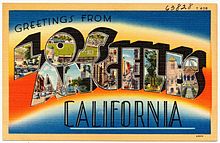
"Large Letter" menu c. 1940s
- Large Alphabetic character
- A postcard that has the proper noun of a place shown as a serial of very large letters, inside of each of which is a picture of that locale (see as well Big Letter).
- Maximum Card
- Postcards with a stamp placed on the picture side of the card and tied by the cancellation, usually the get-go day of issue.
- Midget Postcard
- Novelty cards of the size xc mm × 70 mm (3.54 in × 2.76 in).
- Novelty
- Any postcard that deviates from the norm. These include cards which practise something (such equally mechanical postcards) or which take articles fastened to them.[75] They could also be printed in an unusual size or shape, or fabricated of foreign materials (including leather, wood, metal, silk, or coconut).[75]
- Oilette
- A trade name used by Raphael Constrict & Sons for postcards reproduced from original painting.
- Postcard Folder
- A gear up of picture postcards, printed on light-weight paper, which fold out piano accordion-style from an outer envelope (folder). These typically contain more than 5 cards.
- Postcardese
- The way of writing used on postcards; short sentences, jumping from one subject to some other.
- QSL Card
- Postcards that confirms a successful reception of a radio signal on amateur radio.
- Existent Photographic
- "Real photo postcards", as collectors have dubbed them, are often abbreviated equally "RP" or "RPPC". Nigh of these were produced in small batches from an original negative by an individual or a local store.[37] They are not printed.
- Reward Card
- Cards that were given abroad to school children for skillful piece of work.
- Special Holding Card
- Postcards that are made of a cloth other than paper-thin or contains something made not of cardboard.
- Standard Size
- Introduced in Great britain in November 1899, measuring 140 mm × 89 mm (5.v in × 3.five in).

- Topographical
- Postcards showing street scenes and general views. Judges Postcards produced many British topographical views.
- Undivided Back
- Postcards with a plain dorsum where all of this space was used for the accost. This is usually in reference to early on cards, although undivided were still in common employ upwardly until 1907.
- Vignette
- Ordinarily plant on "undivided dorsum" cards, consisting of a pattern that does non occupy the whole of the film side. Vignettes may be annihilation from a small sketch in one corner of the card, to a design comprehend three quarters of the card. The purpose is to leave some infinite for the message to be written, as the entire reverse of the card could simply exist used for the address.
- Write-Abroad
- A card with the opening line of a sentence, which the sender would and so consummate. Oft constitute on early comic cards.
Gallery [edit]
-

Fortress in Vyborg, postcard from 1917
-

Richmond, Virginia, c. tardily 1923. The intersection shown is at eighth & Wide Streets.
-

German postcard with inscription "This beer belongs to my master!"
-
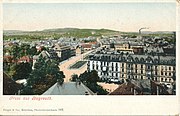
Gruss aus-blazon postcard, published by the Munich based German language printing house Purger & Co.
See likewise [edit]
- Advertising postcard
- Frances Brundage
- Ellen Clapsaddle
- Deltiology
- e-carte
- Francis Frith
- Greeting carte
- Esther Howland
- Judges Postcards
- Mail Art
- Paper sizes
- PHQ Cards
- Postal card
- Postcardware
- Postcrossing
- Postino
- PostSecret
- QSL bill of fare
- Real photo postcard
- F. Grand. O. Stuart
- James Valentine
- Comité des Étudiants Américains de l'École des Beaux-Arts Paris
References [edit]
- ^ a b c d e f yard h i j k fifty thou due north o p q r s t u 5 westward x y z aa ab air-conditioning advertisement ae af ag ah ai aj ak The states Mail (September 2014). "Stamped Cards and Postcards" (PDF). Us Post. Archived (PDF) from the original on 2019-08-26. Retrieved 2020-03-31 .
- ^ a b c d eastward f k h i j thou l m northward o p q r s t u five due west x y z aa ab air conditioning ad ae af ag ah ai aj ak al am an ao ap aq ar every bit at au av "Postcard History | Smithsonian Institution Archives". 2018-11-23. Archived from the original on 2018-xi-23. Retrieved 2020-04-01 .
- ^ "Oldest motion-picture show postcard". Guinness World Records . Retrieved 1 March 2017.
- ^ a b c "Oldest postcard sells for £31,750". BBC News. 2002-03-08. Retrieved 2012-06-16 .
- ^ Arifa Akbar, "Oldest picture postcard in the world snapped up for £31,750", The Contained, ix March 2002.
- ^ "Pre History of the Postcard 1848-1872". Metropolitan Postcard Society of New York City.
- ^ a b c d e f k h i j k fifty m n o p Petrulis, Alan. "MetroPostcard History of Postcards 1873-1897". www.metropostcard.com . Retrieved 2020-04-01 .
- ^ a b c d e f g Cure, Monica (2013-06-22). "Tweeting by mail: The postcard's stormy birth". Los Angeles Times . Retrieved 2020-04-01 .
- ^ a b c d e "Chicago Postcard Museum - How to Age a Postcard". www.chicagopostcardmuseum.org . Retrieved 2020-04-01 .
- ^ a b "Treaties and Other International Agreements of the United states of America 1776-1949 Compiled nether the direction of Charles I. Bevans LL.B." avalon.law.yale.edu . Retrieved 2020-04-01 .
- ^ The New York Times, September 21, 1904.
- ^ "Histoire de la Carte Postale, Cartopole, Baud" (in French). Cartolis.org. Archived from the original on 2011-07-xviii. Retrieved 2012-06-16 .
- ^ Dagmar Breitenbach: Instagram, 19th-century style: The first German postcard In: Deutsche Welle, July 16, 2020, Retrieved 2021-02-07.
- ^ Helmfried Luers: The First Picture Postcard In: The Postcard Anthology #21, Retrieved 2021-02-07.
- ^ Frank Staff, The Flick Postcard & Its Origins, New York: F.A. Praeger, p.51.
- ^ a b c d eastward f g h i j k l m n o p q r due south t u v Bassett, Fred (2018-12-13). "Postcard Collection - Essay, Appendix C: New York State Library". Archived from the original on 2018-12-13. Retrieved 2020-04-01 .
- ^ a b c Petrulis, Alan. "The Peak and Refuse of the Golden Age 1907-1913". world wide web.metropostcard.com.
- ^ a b Baldwin, Brooke (1988). "On the Verso: Postcard Messages every bit a Key to Pop Prejudices". Periodical of Popular Culture. 22 (3): xv–28. doi:ten.1111/j.0022-3840.1988.2203_15.x.
- ^ a b c Petrulis, Alan. "MetroPostcard History of Postcards". www.metropostcard.com . Retrieved 2020-04-01 .
- ^ a b c d e f yard h i j grand Petrulis, Alan. "MetroPostcard History of Postcards 1914-1945". www.metropostcard.com . Retrieved 2020-04-01 .
- ^ Frank Jacob and Mark D. Van Ells, A Postcard View of Hell: One Doughboy's Souvenir Album of the First World War. Wilmington, DE: Vernon Printing, 2019.
- ^ Gendreau, Bianca: Putting Pen to Newspaper, Special Commitment: Canada'south Postal Heritage, ed. Francine Brousseau, Canadian Museum of Civilization, Fredericton 2000, pp. 27-29
- ^ Settembre, Jeanette (30 Sep 2017). "Postcards are becoming extinct and v other industries millennials are killing". MarketWatch . Retrieved 2021-02-01 .
{{cite web}}: CS1 maint: url-status (link) - ^ "Postcards on the border as U.k.'due south oldest publishers signs off". The Guardian. 2017-09-25. Retrieved 2021-02-01 .
- ^ The Imperial Gazetteer of India. (1908). Vol 3 (Economic), p. 424
- ^ a b "PostcardGuide Japan/Konnichiwa!". www.photojpn.org.
- ^ PostcardGuide Japan, April 2, 1997
- ^ "ГОСТ Р 51507-99 - НАЦИОНАЛЬНЫЕ СТАНДАРТЫ". protect.gost.ru.
- ^ Willoughby, Martin (1992). A History of Postcards. London England: Bracken Books. p. 160. ISBN1858911621.
- ^ Sept and Dec 1991 Picture Postcard Monthly
- ^ PPC Almanac 2015
- ^ Nick Collins (5 August 2010). "Bawdy seaside postcards on brandish". The Telegraph. Archived from the original on 2022-01-12. Retrieved 12 September 2011.
- ^ a b Petrulis, Alan. "Mail service Carte du jour undivided". world wide web.metropostcard.com . Retrieved 2020-04-01 .
- ^ a b Gifford, Daniel (2013) American Holiday Postcards 1905-1915: Imagery and Context. McFarland Press. ISBN 0786478179.
- ^ a b c d e f chiliad "Chicago Postcard Museum - Postcard Era History". world wide web.chicagopostcardmuseum.org . Retrieved 2020-04-03 .
- ^ a b c d e f g h Ellison, Todd (2006-08-07). "Tips for determining when a U.South. postcard was published". www.fortlewis.edu . Retrieved 2020-04-01 .
- ^ a b Palmer, Richard. "Postcard Craze Engulfs the Bang-up Lakes". Inland Seas. l (1): 39–45.
- ^ "Leather Postcards". Flickr. 25 March 2017. Retrieved 2020-04-01 .
Sending and receiving postcards between 1907 and 1915 were the equivalent to the text-messaging communication miracle of today. A item genre from the early on 1900 to 1909 was the novelty postcard produced on leather, more usually referred to as leather postcards. Although leather postcards became quite popular, they were banned for postal use by the U.s.a. Post in 1909. Thus, leather postcards postmarked after 1909 tend to be very rare - though not unseen.
- ^ Aizenberg, Salo (2013). Hatemail: Anti-Semitism on Motion-picture show Postcards. The Jewish Publication Order. p. 121. ISBN978-0827609495.
Leather postcards were novelty items pop in the United States from around 1900 to 1909, when they were banned by the mail service part due to the difficulty of processing the leather in sorting machines. Leather postcards were produced both by commercial publishers and by individuals who purchased the raw leather and used burning kits to create the image.
- ^ Tribune-Herald, Terri Jo Ryan Special to the. "Brazos By: Leather postcards from early on 20th century present unique slices of life". WacoTrib.com . Retrieved 2020-04-01 .
These leather postcards were a fad from about 1900 until 1909, when they were banned by the U.S. Mail because of the harm they inflicted on sorting machinery.
- ^ "Brusque-lived frenzy over leather postcards – Auction Finds". eight August 2016. Retrieved 2020-04-01 .
- ^ "[Untitled]". The Goldfield News (Goldfield, Nevada). 1904-07-29. p. 1.
J. W. Halterman received a burnt leather souvenir postal card from his wife Wed, on which was the motion-picture show of a carry chasing a man upward a tree and the inscription, "no time to write from Colorado." He immediately took an ordinary postal, drew a picture of a man chasing a acquit up a tree, wrote at the side "no fourth dimension to write from Nevada" and sent it on to his wife.
- ^ "[Untitled]". The Winfield Daily Free Press (Winfield, Kansas). 1904-09-27. p. 8.
"Doc" Johnson has honored the Free Printing with a leather mail bill of fare from Colorado.
- ^ "[Untitled]". Tri-City Evening Star (Davenport, Iowa). 1904-x-01. p. 8.
Justice L. E. Roddewig this morning received a leather postal card from a Davenport friend visiting in Omaha. The menu is certainly a novelty.
- ^ "A Postal Card of Leather". Sterling Evening Gazette (Sterling, Illinois). 1904-10-12. p. ii.
Scott Williams has begun the making of a new article of pyrography which is certain to prove exceptionally popular. It is a lweather post card, to be used as a gift of Sterling, upon the back of which is a photo of Sterling scenery or buildings and suitable inscriptions washed with the red hot point. The card is attractive and there is no doubt that Mr. Williams will secure many orders.
- ^ "[Untitled]". The Miami News (Miami, Florida). 1904-10-13. p. v.
The Metropolis is in receipt of a pretty burnt leather souvenir postal service-card from Mr. East. F. Boss, of Petoskey, Mich., which is dated the 10th, and shows he and family unit "starting for Miami."
- ^ "Leather Postal Menu". Logansport Pharos Tribune (Logansport, Indiana). 1904-10-nineteen. p. 8.
Dr. J. A. Little received a souvenir leather postal card from Dr. A. J. Herrmann who, with his wife and family unit are sojourning in California, this morning stating that he would be domicile Sun. He writes that his married woman and children take gained very much in flesh and that they are enjoying the trip immensely. The carte du jour was mailed at Los Angeles.
- ^ "Valentine Twenty-four hours About". Dixon Evening Telegraph (Dixon, Illinois). 1905-02-01. p. v.
Pretty hearts of forest are prepared and decorated with beautiful Christy or Gibson heads on them. They tin can be sent through the mail with address on one side but like a post carte du jour. These with the leather post card will be very pop this year. There are also the heart shaped handkercief [sic] boxes with advisable pictures burnt on them. All of these things tin can likewise exist put in watercolors and this seems to be quite the matter now.
- ^ "[Untitled]". Sterling Daily Standard (Sterling, Illinois). 1905-02-06. p. 8.
Scott Williams says that the leather post card valentines are making a great chip and that his orders for them have caused him to increment the output of them as rapidly as possible. Whole sheep skins are cut into postal service card size and and so pictures burned on them with appropriate wording, or painted in h2o colors. The Bloomington agency is demanding large quantities and 2nd orders have come from Champaign, Rockford, Dixon and Clinton, Ia. Four artists are at work steadily at the studio.
- ^ "History & Innovation". Bostonhistorycollaborative.org. Retrieved 2012-06-sixteen .
- ^ "Springfield 375 | Springfield's Official 375th Ceremony Celebration Site". Springfield375.org. Archived from the original on 2012-04-05. Retrieved 2012-06-16 .
- ^ a b c "The History of Postcards".
- ^ Willoughby, Martin (1992). A History of Postcards. London England: Bracken Books. p. 42. ISBN 1858911621.
- ^ "An Act To amend the postal laws relating to utilize of postal cards" (PDF). United States Congress Statutes at Large. 20: 358. Archived from the original (PDF) on 2017-07-02.
- ^ a b "Post Carte du jour Situation". The American Stationer. 65: 26. 1910-04-23. hdl:2027/nyp.33433090917406.
- ^ "Tariff Bill Comparisons". Geyer's Stationer. 48: 1 & twenty. 1909-08-12. hdl:2027/nyp.33433108136940.
- ^ "Post Card State of affairs: New Loftier Tariff Causes Strange Manufacturers To Make Plans For American Factories--High german Firms Active". Geyer's Stationer. 48: 6. 1909-11-04. hdl:2027/nyp.33433108136940.
- ^ "German Dyes Scarce". Geyer'due south Stationer. 58: 27. 1915-05-xx. hdl:2027/nyp.33433108135934.
- ^ "Guide to Dating Curt Teich Postcards" (PDF). Newberry Library. 2016.
- ^ Linen Cards. Metropolitan Postcard Club of New York City.
- ^ Edwards, Elizabeth (1996). The Tourist Prototype: Myths and Myth Making in Tourism. West Sussex PO19 1UD, England: John Wiley and Sons. pp. 199–200. ISBN0-471-96309-vii.
{{cite volume}}: CS1 maint: location (link) - ^ "USPS - Mail service Characteristics - Sizes for Cards". USPS. Archived from the original on 2008-01-20. Retrieved two June 2011.
- ^ "Naked motion-picture show postcards returned to sender". BBC News. 30 July 2001. Retrieved 2011-06-05 .
- ^ a b c d Kim, Linda (2012). "A Law of Unintended Consequences: United States Postal Censorship of Lynching Photographs". Visual Resources. Taylor & Francis. 28 (ii): 171–193. doi:10.1080/01973762.2012.678812.
- ^ Apel, Dora (2004). Imagery of Lynching: Blackness Men, White Women, and the Mob. New Brunswick, N.J.; London: Rutgers Academy Press. ISBN 978-0-8135-3459-6.
- ^ a b c d east f g h i j chiliad l m Demm, Eberhard. "Censorship | International Encyclopedia of the First World War (WW1)". International Encyclopedia of the Outset World War. Archived from the original on 2020-01-20. Retrieved 2020-04-03 .
- ^ a b c "Circumventing the censorship and "self-censorship"". The World of the Habsburgs. Archived from the original on 2018-12-21. Retrieved 2020-04-02 .
- ^ a b c Hanna, Martha (2014-10-08). "War Messages: Communication between Front end and Home Front end | International Encyclopedia of the Showtime World War (WW1)". International Encyclopedia of the First Globe State of war. Archived from the original on 2019-03-26. Retrieved 2020-04-03 .
- ^ Farfan, P. (2012). ""The Moving-picture show Postcard is a sign of the times": Theatre Postcards and Modernism". Theatre History Studies. 32: 93–119. doi:x.1353/ths.2012.0018. S2CID 192002863.
- ^ Vanderwood, Paul (1988). "Writing History with Pic Postcards". The Journal of San Diego History. 34 (ane). Archived from the original on 2016-06-29.
- ^ "Erstwhile Postcards: Letters about the By". Primary Source Bazaar. 24 May 2019.
- ^ "18 August 1906". The American Stationer. Vol. 60. Redman & Kerry. 1906. p. viii.
- ^ "Postcards on Colnect". colnect.com . Retrieved 2019-01-31 .
- ^ "Metropolitan Postcard Gild of New York City". www.metropolitanpostcardclub.com . Retrieved 2020-04-01 .
- ^ a b "Novelty leather postcards". Barr's Postcard News & Ephemera. 2016-eleven-21.
Novelty postcards include Hold-to-lights, Die-cuts, leather, silk or metal applied, printed on silk, burnt wood, mechanical and on and on. They are just about anything only the apartment printed or real photo postcards. One category is postcards made of leather.
External links [edit]
 | Wikimedia Eatables has media related to Postcards. |
- The Postcard Traders association—Represents professionals within the U.k. postcard industry.
- The International Federation of Postcard Dealers—Represents professional postcard dealers worldwide.
- Japanese Postcard Collecting Enquiry きのう屋日本の絵葉書コレクション
- Bowden Postcard Drove Online. Approximately 10,000 digitized postcards, maintained by the Walter Havighurst Special Collections in the Miami Academy Libraries.
- abadie.co.united kingdom of great britain and northern ireland, currently the simply book of classic John Hinde postcards with the senders letters transcribed
- johnhindecollection.com, a website dedicated to John Hinde Postcards
- "Plowman Family unit Postcard Collection". University of St. Michael's College, John K. Kelly Library. Retrieved 15 October 2015.
-
 The full text of A New Thing in Stamp (study on the commencement cheap postcard used in Republic of austria) at Wikisource
 - PostcardTree. thirty,000+ digitized and postally used postcards.
- Newberry Postcards at Internet Archive - digital collection of 26,000+ postcards
- National Trust Library Historic Postcard drove at the Academy of Maryland libraries
- Institute of American Deltiology Postcard collection at the University of Maryland libraries
Source: https://en.wikipedia.org/wiki/Postcard

Post a Comment for "double side 3d letters sign side view drawing"