What Is the Role of Art in Protesting War?


Gratuitous spoken communication flag containing the AACS keys.

Protest art is the creative works produced past activists and social movements. It is a traditional means of communication, utilized by a cross section of collectives and the state to inform and persuade citizens.[1] Protest art helps agitate base emotions in their audiences, and in return may increase the climate of tension and create new opportunities to dissent. Since art, unlike other forms of dissent, take few financial resources, less financially able groups and parties can rely more on performance art and street art as an affordable tactic.[1]
Protest art acts as an important tool to class social consciousness, create networks, operate accessibly, and be cost-effective. Social movements produce such works every bit the signs, banners, posters, and other printed materials used to convey a particular crusade or bulletin. Oft, such art is used as part of demonstrations or acts of civil disobedience. These works tend to be ephemeral, characterized past their portability and disposability, and are oft non authored or endemic by whatever one person. The various peace symbols, and the raised fist are 2 examples that highlight the democratic buying of these signs.
Protest fine art also includes (merely is not limited to) performance, site-specific installations, graffiti and street art, and crosses the boundaries of Visual arts genres, media, and disciplines. While some protest art is associated with trained and professional person artists, an extensive knowledge of art is not required to accept function in protest fine art. Protest artists oftentimes bypass the art-globe institutions and commercial gallery system in an attempt to reach a wider audition. Furthermore, protest fine art is not limited to i region or country, simply is rather a method that is used effectually the globe.
There are many politically charged pieces of fine art — such as Picasso'southward Guernica, some of Norman Carlberg'south Vietnam state of war-era piece of work, or Susan Crile's images of torture at Abu Ghraib.
History [edit]
Information technology is difficult to constitute a history for protest art because many variations of information technology tin be found throughout history. While many cases of protest art can be found during the early 1900s, similar Picasso's Guernica in 1937, the last 30 years[ when? ] has experienced a big increment in the number of artists adopting protest fine art equally a style to relay a message to the public.

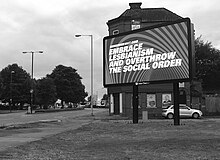
Digital billboard in Manchester UK displaying protest art by Martin Firrell
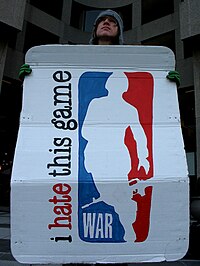
A slice of protestation art featuring a parody of the logo of the NBA.
Every bit awareness of social justices around the world became more common among the public, an increase in protest fine art can be seen. Some of the nigh critically effective artworks of the contempo catamenia[ when? ] were staged outside the gallery, abroad from the museum and in that sense, protest art has found a different human relationship to the public.
Activist art [edit]
Activist fine art represents and includes aesthetic, sociopolitical, and technological developments that have attempted to challenge and complicate the traditional boundaries and hierarchies of civilisation equally represented past those in power. The aim of activist artists is to create art that is a form of political or social currency, actively addressing cultural power structures rather than representing them or simply describing them.[two] Like protest fine art, activist art practice emerged partly out of a telephone call for fine art to be connected to a wider audience, and to open up upwardly spaces where the marginalized and disenfranchised can be seen and heard.
Activist art incorporates the use of public space to address socio-political bug and to encourage community and public participation as a means of bringing about social change. It aims to bear upon social modify by engaging in active processes of representation that work to foster participation in dialogue, heighten consciousness, and empower individuals and communities. The need to ensure the continued affect of a piece of work by sustaining the public participation process it initiated is also a challenge for many activist artists. It often requires the artist to establish relationships inside the communities where projects take place.
If social movements are understood every bit "repeated public displays" of alternative political and cultural values,[3] then activist art is significant in articulating such alternative views. Activist art is as well of import to the dimension of culture and an agreement of its importance alongside political, economical, and social forces in movements and acts of social alter. Ane should exist wary of conflating activist art with political art, equally doing and so obscures critical differences in methodology, strategy, and activist goals.
Historical ground in art and politics [edit]
Activist art cites its origins from a particular artistic and political climate. In the fine art globe, operation art of the late 1960s to the 70s worked to broaden aesthetic boundaries within visual arts and traditional theatre, blurring the rigidly construed distinction between the two. Protest fine art involves artistic works grounded in the deed of addressing political or social issues. Protest art is a medium that is accessible to all socioeconomic classes and represents an innovative tool to expand opportunity structures. The transient, interdisciplinary, and hybrid nature of performance art allowed for audition engagement. The openness and immediacy of the medium invited public participation, and the nature of the creative medium was a hub for media attention.
Emerging forms of feminism and feminist art of the time was particularly influential to activist art. The Feminist Art motion emerged in the early 60s during the Second Wave of Feminism. Feminist artists worldwide ready out to re-plant the founding pillars and reception of contemporary art. The movement inspired change, reshaped cultural attitudes and transformed gender stereotypes in the arts. [4] The idea that "the personal is the political," that is, the notion that personal revelation through art can be a political tool,[five] guided much activist art in its study of the public dimensions to private experience. The strategies deployed by feminist artists parallel those past artists working in activist art. Such strategies frequently involved "collaboration, dialogue, a constant questioning of aesthetic and social assumptions, and a new respect for audience" and are used to clear and negotiate issues of self-representation, empowerment, and community identity.
Conceptual Fine art sought to expand aesthetic boundaries in its critique of notions of the art object and the article arrangement within which it is circulated as currency. Conceptual artists experimented with unconventional materials and processes of art production. Grounded by strategies rooted in the real world, projects in conceptual art demanded viewer participation and were exhibited outside of the traditional and exclusive infinite of the art gallery, thus making the work accessible to the public. Similarly, collaborative methods of execution and expertise fatigued from outside the art earth are often employed in activist art then equally to attain its goals for community and public participation. Parallel to the emphasis on ideas that conceptual art endorsed, activist art is process-oriented, seeking to expose embedded power relationships through its procedure of creation.
In the political sphere, the militancy and identity politics of the period fostered the conditions out of which activist art arose.
Strategy and practice [edit]
In practise, activist art may often accept the form of temporal interventions, such as performance, media events, exhibitions, and installations. It is also common to employ mainstream media techniques (through the use of billboards, posters, ad, newspaper inserts…etc.). By making employ of these commercial distributive channels of commerce, this technique is particularly constructive in conveying letters that reveal and subvert its usual intentions.
The utilize public participation equally a strategy of activating individuals and communities to get a "goad for change" is important to activist fine art. In this context, participation becomes an human action of self-expression or cocky-representation by the unabridged community. Creative expression empowers individuals by creating a space in which their voices can exist heard and in which they can engage in a dialogue with one some other, and with the issues in which they take a personal stake.
The Artist and Homeless Collaborative is an instance of a projection that works with strategies of public participation as a means of individual and community empowerment. It is an affiliation of artists, arts professionals and women, children and teenagers living in NYC shelters, the A & HC believe that their work in a collaborative project of art-making offers the residents a "positive feel of self-motivation and helps them regain what the shelter system and circumstances of lives destroy: a sense of individual identity and confidence in human interaction."[6] The process of engaging the community in a dialogue with dominant and public discourses about the issue of homelessness is described in a statement past its founder, Hope Sandrow: "The relevancy of fine art to a customs is exhibited in artworks where the homeless speak directly to the public and in word that consider the relationship fine art has to their lives. The do of creating art stimulates those living in shelters from a state of malaise to active participation in the artistic process"[7]
The A & HC came into being at a time when a critique of the makers, sellers, and consumers of art that addressed social concerns became increasingly pronounced. Critics argued that the very works of art whose purpose was to provoke political, social and cultural conversation were confined within the sectional and privileged space of galleries museums, and private collections. Past contrast, the A & HC was an try to span the gap betwixt fine art production and social action, thus allowing for the piece of work subjects that were previously excluded and silenced to be heard.
Ongoing Activist Fine art [edit]
Activist art can often be ongoing or community oriented- an instance is the Read Opera The Charter of the Forest, which updates every 2 weeks and has a following of activists. In general, Read Opera is intended to be a genre of activist fine art, stemming from its nature every bit a free and anti-advertising form of expression. It rejects the manipulative practices of art-for-profit, and takes as given that culture is a right, non a privilege.[viii] The Lease of the Forest specifically deals with the ramifications and ideas surrounding nonviolence and what it means for political structures, taking cues from Noam Chomsky and Leo Tolstoy.[ix]
Resistance art [edit]
Resistance art is art used every bit a mode of showing their opposition to powerholders. This includes art that opposed such powers as the German Nazi political party, as well as that opposed to apartheid in South Africa.[10] The Soweto insurgence marked the starting time of social change in S Africa. Resistance art grew out of the Black Consciousness Movement, a grass-roots anti-Apartheid movement that emerged in the 1960s lead past the charismatic activist Steve Biko. Much of the fine art was public, taking the course of murals, banners, posters, t-shirts and graffiti with political messages that were confrontational and focused on the realities of life in a segregated Due south Africa. [11] Willie Bester is ane of South Africa'south most well known artists who originally began equally a resistance artist. Using materials assembled from garbage, Bester builds upwards surfaces into relief and and so paints the surface with oil paint. His works commented on important black South African figures and aspects important to his community. South African resistance artists do not exclusively deal with race nor practice they take to be from the townships. Another creative person, Jane Alexander, has dealt with the atrocities of apartheid from a white perspective. Her resistance art deals with the unhealthy society that continues in postal service-apartheid Due south Africa.[12]
Collections [edit]
The Eye for the Study of Political Graphics archive currently contains more than 85,000 posters and has the largest collection of mail service-World War II social justice posters in the United States and the second largest in the earth.[13] Many university libraries take extensive collections including the Joseph A. Labadie Collection at University of Michigan documents the history of social protest movements and marginalized political communities from the 19th century to the nowadays.[14]
Run into as well [edit]
- Anti-monumentalism
- RevolutionArt (activist fine art magazine)
- Sandwich board
- Guerrilla Girls
- Object Orange
- Graffiti
- Prof. Abdul Rahim Nagori (socio-political painter)
- Anica Nonveiller
- Hans Burkhardt
- Martin Firrell
- Paweł Kuczyński
- Performers and Artists for Nuclear Disarmament
- Aestheticization of politics
- Mattress Performance (Carry That Weight)
References [edit]
- ^ a b Chaffee, Lyman (1993). Political protest and street art: Popular tools for democratization in hispanic countries. Westport, Connecticut: Greenwood Press.
- ^ Tate. "Activist fine art – Art Term". Tate . Retrieved 2022-01-08 .
- ^ Reed, T.Five., The art of protestation : civilization and activism from the civil rights move to the streets of Seattle. (Minneapolis: University of Minnesota Press, 2005) xiv.
- ^ "A Guide to the Feminist Art Movement". Ascension Art . Retrieved 2022-01-08 .
- ^ Suzanne Lacy, ed. Mapping the Terrain: New Genre Public Fine art. (Seattle: Bay Press Inc., 1995) 27
- ^ Wolper,Andrea. Making Art, Reclaiming Live: The Artist and Homeless Collaborative. (Seattle: Bay Press Inc., 1995) 252-253
- ^ Wolper,Andrea. Making Art, Reclaiming Live: The Creative person and Homeless Collaborative. (Seattle: Bay Press Inc., 1995) 253
- ^ "About the Read-Opera". The Charter of the Forest. 2019-09-sixteen. Retrieved 2020-03-21 .
- ^ "i.1.xx: The Offset Conversation with The Quality of Mercy". The Charter of the Woods. 2020-01-01. Retrieved 2020-03-21 .
- ^ "Archived copy". Archived from the original on 2012-03-eleven. Retrieved 2011-04-03 .
{{cite web}}: CS1 maint: archived re-create equally title (link) - ^ "Resistance Art". tate.org.
{{cite web}}: CS1 maint: url-condition (link) - ^ Sue Williamson, Resistance Art in South Africa (1989)
- ^ Sheff, Harry. "The Center for the Written report of Political Graphics". Utne Reader. Retrieved 4 October 2016.
- ^ "Joseph A. Labadie Collection of Social Protest". Arts & Civilisation. University of Michigan. Retrieved 3 April 2017.
Further reading [edit]
- Fine art under dictatorship by Prof. A. R. Nagori
- Tom Bieling (Ed.): Design (&) Activism – Perspectives on Design as Activism and Activism every bit Pattern. Mimesis, Milano, 2019, ISBN 978-88-6977-241-2.
- Felshin, Nina. Just Is Information technology Art? The Spirit of Art equally Activism. Seattle: Bay Press Inc., 1995.
- Grindon, Gavin. "Surrealism, Dada and the Refusal of Work: Autonomy, Activism, and Social Participation in the Radical Advanced," The Oxford Art Journal, 34:1, 2011.
- Groundswell Collective. Groundswell | A Periodical of Art and Activism: Event 00. 2010.
- Lacy, Suzanne. Mapping the Terrain: New Genre Public Art. Seattle: Bay Printing Inc., 1995.
- Muller, Mary Lee ; Elvehjem Museum of Art. Imagery of dissent : protest art from the 1930s and 1960s : March 4 - April 16, 1989, Elvehjem Museum of Art, Academy of Wisconsin–Madison (Madison, Wis. : The Museum, ©1989) ISBN 0-932900-20-8 (exhibition devoted to two periods of intensely political protest fine art: the Spanish Civil War and America's Vietnam War)
- Perry, Gill, and Paul Forest, eds. Themes in Gimmicky Art. New Haven: Yale University Press, 2004.
- Reed, T.V. The fine art of protest : civilisation and activism from the civil rights move to the streets of Seattle. Minneapolis: Academy of Minnesota Press, 2005.
- Robertson, Jean. "Themes of Contemporary Art - Visual Art after 1980". New York: Oxford University Press, Inc. 2005.
- Wolper, Jean. "Making Art, Reclaiming Lives: The Artist and Homeless Collaborative." Just is information technology Fine art? The Spirit of Art as Activism. Ed. Nina Felshin. Seattle: Bay Press Inc., 1995.
External links [edit]
"Street" protest art [edit]
- Hand-held signs are the primary medium in protest art
- Creativity and humor are often evident in street protest art - as with these "Tv-headed" activists
- Scene from a piece of political performance art (from digitaljournalist.org)
- Plazm mag: A visual fourth dimension line of post-World War II anti-war graphics
- Protest Street Fine art Archive | Groundswell
Political protest in fine fine art [edit]
- Vietnam-era antiwar piece by Norman Carlberg
- Susan Crile artworks based on images of torture at Abu Ghraib prison in Iraq
- Noam Avidan-Sela, The Slap-up Amanuensis of Western Colonialism, Eretz Acheret Magazine
Source: https://en.wikipedia.org/wiki/Protest_art

Post a Comment for "What Is the Role of Art in Protesting War?"